- Updated September 25, 2025
New Vacuum Tubes
When to Replace Tubes
Normally, vacuum tubes slowly deplete themselves over their lifetime. When their power dissipation dips much below their original specification, the output power and sound quality declines. The sound will begin to lose its definition, color and overall dynamic drive. For the large power output tubes in Wright Audio’s single-ended integrated and power amplifiers, these qualities can occur at about the 1500 hour mark and at about 2500 hours in our push-pull amplifiers. It is very important to replace the tubes at these points. You may think after 3 or 4 years of moderate use that the amplifier sounds fine, but the degradation is so subtle and over such a long period of time, that only new tube substitution will remind you of the full sonic capabiilties of the equipment.
Besides the sound quality degradation, it is especially important that you replace power tubes at this time to avoid a possible catastrophic failure which may lead to an expensive amplifier repair. Never run tubes past the expected lifetime waiting years until one fails altogether in order to replace it. However, Wright Audio amplifiers are built to endure some abuse through over-design with parts operating at a fraction of their capability as well as having fuse protection.
Smaller tubes should be replaced at about the 2500 hour mark. Besides the degradation in sound quality, small tubes can cause noise in the form of static, hum or hiss.
You should always keep a full set of replacement tubes on hand to make a substitution in case a problem develops.
Never substitute a tube with a number different from what was originally installed on your amplifier, or noted on the top, back or bottom of the equipment. Contact Wright Audio if you have a question regarding substitution of a tube number.
How To Change Tubes
Grasp the expired large power and rectifier tubes by the base, not the glass. Pull straight out. Do not rock the tubes back and forth in an effort to extract them. You may break off the guide post which will remain in the socket and be impossible to remove without opening the amplifier. Likewise, pull the smaller tubes straight out, as it is possible to crack the glass at the bottom of the tube with excessive rocking.
Wash your hands before inserting the new tubes. It is inevitable that your hands will contact the glass. Vacuum tube bulb temperatures for the power tubes can reach around 200 to 250 degrees celsius or about 400 to almost 500 degrees Fahrenheit. If your hands are not clean, whatever has been deposited onto the power output tubes during installation will cause them to smell for awhile after they heat up!
To insert the new power and rectifier tubes, visually inspect the tube’s bottom post to orient the ‘key’ with the notch in the socket. This is important because due to manufacturing tolerances of both the tube and the socket, it is sometimes still possible to insert the tube with an incorrect orientation which will damage the tube and likely the amplifier once it is turned on.
Grasping the base, press the tube straight down into the socket. Do not rock it excessively since again, the tube’s center post can break.
On the smaller tubes, a gap exists in the pins which serve for alignment in their appropriate sockets.
Set the Tube Bias
Most Wright Audio amplifiers do not require the user to make this electrical adjustment as it is done automatically. For those amplifiers with a bias adjustment, consult the manual with the amplifier for the procedure and setting.
New Tube Warranty
New tubes have a 90 day warranty from receipt.
These recommended, replacement tubes from Wright Audio are selected to perform best in
Wright Audio products.
Unlike tubes supplied by musical instrument suppliers, the replacements listed here have been tested and selected for high fidelity use under the operating parameters specifically required by high fidelity amplifiers.
The appropriate tubes are selected and matched for current, transconductance (gm) and lowest noise.
Contact us to discuss any questions you might have regarding suitability of specific tubes for your Wright Audio product.
Please note that there is no one ‘best’ tube of the same number for all applications. An ECC83 / 12AX7 from one manufacturer may sound better than another, but only for a specific position in a certain circuit.
This is why we suggest a variety of manufacturers’ tubes of the same number.
Due to price and supply fluctuations, please contact inform@WrightAudioArts.com
for current availability, pricing and to purchase.
Power Output Tubes
All power output tubes are normally sold as matched pairs or quads.
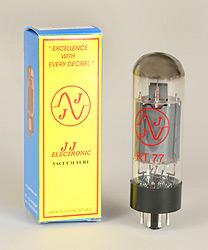
JJ KT77
These are the least expensive, excellent-sounding output tubes recommended for our single-ended and push-pull amplifiers. Bold, clear tone, open highs with excellent dynamics.
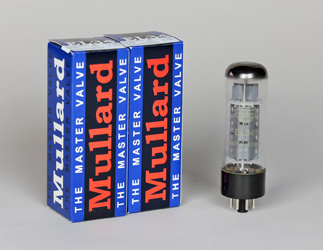
Reproduction Mullard EL34
These are very smooth and retrieve a recording’s ambience and spatial depths beautifully,
while providing rich harmonics.
while providing rich harmonics.
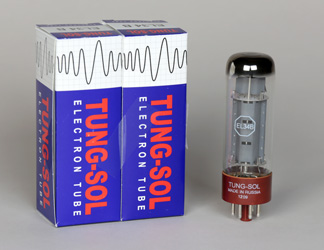
Tung-Sol EL34B
The Tung Sol EL34B’s are smooth, musical and refined-sounding with slightly richer harmonics than the JJ’s.
Extremely pleasant, natural and well-balanced.
Extremely pleasant, natural and well-balanced.
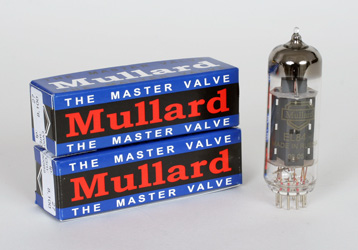
Reproduction Mullard EL84
Recommended as best for the Mini Amplifier in conjunction with the Tung-Sol 12AX7.
Recommended but not currently sold by Wright Audio.
Preamplifier Tubes
Some phono and line level stages may require sections of each tube to be matched within 10%.
There is a small extra charge.
There is a small extra charge.
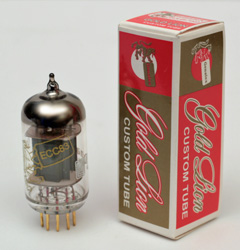
REPRODUCTION GENALEX LARGE PLATE ECC83 / 12AX7 / B759
Rich, colorful sound with great detail.
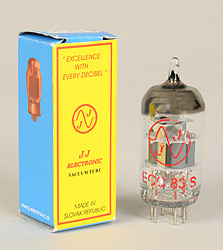
JJ ECC83S / 12AX7
Special frame grid construction provides a very clear sound.
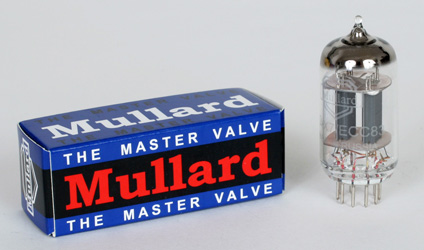
Reproduction Mullard ECC83 / 12AX7
Extremely rich harmonics, musical sound. Excellent soundstaging and imaging. Closely matched sections.
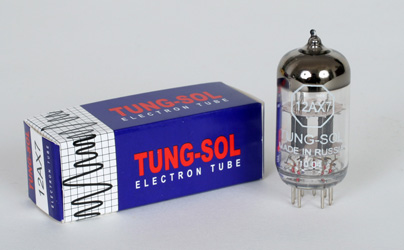
Tung-Sol 12AX7
Very musical tube with great detail. Especially recommended for use with the Mini Amplifier.
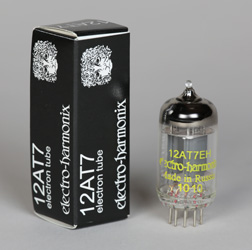
ELECTRO-HARMONIX 12AT7
Large plates with closely matched sections.
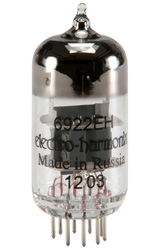
Electro-Harmonix 6922
Evenly-balanced, musical tube with great detail.
Selected for closely matched sections. An industry standard.
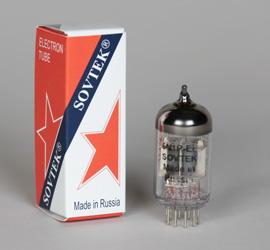
Sovtek 6N1P-EB
Beautiful-sounding tube with a vivid, illuminated midrange. Selected for closely matched sections.
Rectifier Tube
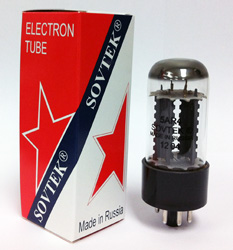
Sovtek 5AR4
Selected for matched sections.